

The beer trivia hunter
23.08.2023

All materials are intended for adults over the age of 18 only and should not be passed on or made available to persons under the age of 18.

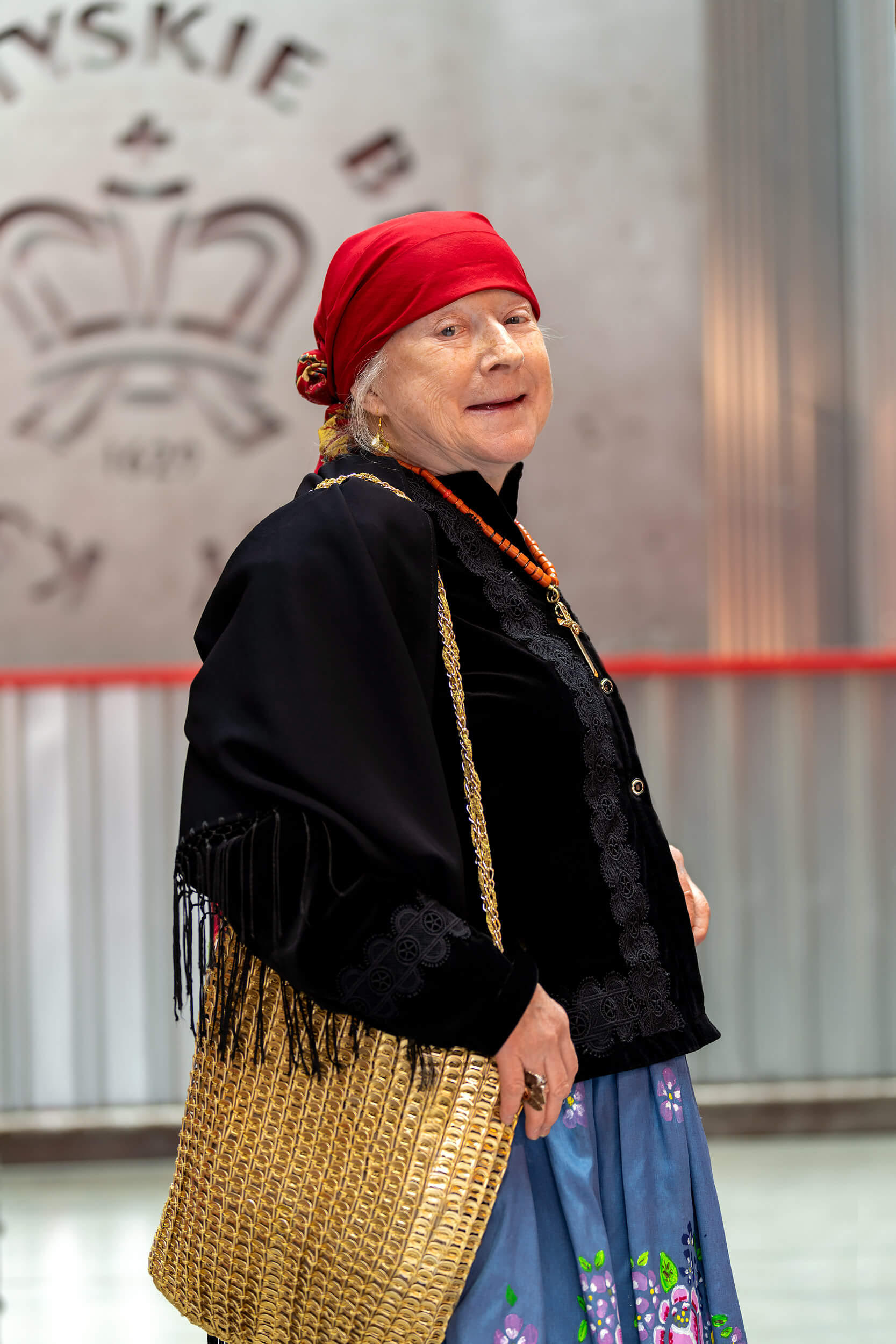
A true Silesian through and through, woman of many talents, colorful and exceptional personality, long-time tour guide at Tyskie Browary Książęce. She shared with us some stories of the coincidences in her life, ideas that come to her from outer space, and a few of the dozens of anecdotes that entertain visitors to the Tyskie brewery.
How did I end up at TBK? They were looking for a guide who would conduct tours in German. I was convinced that I knew German, but when I received a list of 300 brewing- related words, I was a bit overwhelmed. I had to learn new vocabulary – before that, I had never needed German translations for words like “wort”.
How did the idea of conducting tours in Silesian dialect come about? We came up with it ourselves. At the beginning, it was pretty epic; we played musical instruments and had our own Tyskie anthem.
Our Silesian Tyskie beer is yummy
People enjoy it worldwide like honey
Only fools say no to this brew
So you, my friend, drink up too
Once you’ve finished the beer
You’ll live better, have no fear
Even when life is tough
Tyskie cheers you up enough
We created this project several years ago. First of all, we had to prepare clear Silesian dialect translations of the texts. However, it wasn’t just a direct translation; we adapted the text we use for tours in Polish into the Silesian dialect. In the end, it was reviewed for accuracy by the historian Tomasz Wrona.
The texts were translated by four „Silesian” guides, who encountered some surprising challenges. They told me, “Since you are a technologist, you should translate the modern terms.” Meanwhile, they stuck to the phrases they were familiar with. What did we find out? Even though we are all from the same region, with Ewa from Piaski, Dorota from Tychy, me from Hajduki (today’s Chorzów-Batory), and Michał from Mysłowice, we argued over single words. That is exactly why there is no uniform Silesian dialect – there are significant differences within it. Take a word like ‘rogolka’. It is used here (Tychy), but where I am from, we say ‘kwyrlok’. I once had the pleasure of giving a tour around the brewery to Janusz Gajos and his wife. After the tour, I mentioned the same thing, and Mr. Gajos’ wife said, “In Wrocław, we call it ‘kwirlejka'”. It turned out that even a simple item like a whisk for stirring sour milk has many names in different regions – in Krakow, for example, it is called ‘kołatka’.
I also struggled with ‘tankofermentors’ which are fermentation tanks – how to translate that name? So, I created a word, and it later made it into the “Competition for the Most Beautiful Silesian Word” almanac. A fermentation tank is a large metal vessel, which we call ‘putnia’ in the Silesian dialect. And since it is used for the purpose of fermentation, which for us is ‘gerowanie’, it became ‘putnia gerowa’. My boss at the time suggested that it was so cool that we should add a description and submit it to the competition. We sent in our entry, and ‘putnia gerowa’ made it into the almanac. It did not win, but it is there – along with a drawing of fermentation tanks.

I also give tours in German. I do know the language, I passed exams at the Goethe Institute, and I attended a course in Hamburg, so I am able to separate the Silesian dialect from Germanisms. Wherever possible, I simply use native words to replace them. Unfortunately, sometimes it is not possible; for example, ‘lajtung’, which means cable, is a typical Germanism. Moreover, if you look closely, there are plenty of Germanisms in the Polish language. ‘Burmistrz’ (mayor), ‘ratusz’ (town hall), ‘ślusarz’ (locksmith) – all of these come from the German language. Language is fluid. Nowadays, we use many Americanisms, and my generation introduced Russian words into our speech. Language is alive, contrary to Latin.
The thing about the Silesian dialect is that certain ideas can be expressed directly, which may not always be appropriate in Polish.
Tours around Silesia often attract people from outside the region, who listen to the Silesian dialect with respect and great interest. Meanwhile, visiting Silesians want to prove that they are better than me. Those from outside of Silesia are usually delighted, and when I occasionally suggest that I will speak partially in Polish, they strongly object.
During the tours, there is one recurring situation I find quite amusing. When we are in the brewhouse, and I encourage the visitors to pay attention to some unique tiles, but since they do not understand the sentence in the Silesian dialect, they just look and look… And I finally switch to Polish and say, “Ladies and gentlemen, please have a look at these columns with tiles at the top”, they often burst into wild laughter.
Visitors often have their own theories. It is truly incredible! It might not be a romantic place, since these tanks are cold, but it is definitely hygienic. There are 1,000 checks throughout the entire beer brewing process, which is quite amazing! Yest visitors will still say that beer from a barrel was something special. Not true! Brewers say that after emptying the barrels, they smelled bad! They had to be cleaned and sealed – yet many guests talk about how beerfrom a barrel used to be the best.
For us, the guides in Tychy, the tourist season is officially open when someone from the visitors asks if we are still adding bile to the beer. I have no idea where this even came from.It is a myth that originated during times when meat was rationed.
Moreover, it is a common occurrence that homebrewers come for a visit to test my knowledge.
About a group that left a lasting impression on me
I remember one specific event with a group of seniors from Krakow – retired professors, lawyers, and doctors. I said to them, “If anyone needs to go to ‘haźla,’ it is down there and to the left,” and one of the guests asked me, “What is ‘haźla’?” I replied, “Oh, you poor ‘gorole’ (non-Silesians).”
The group was thrilled with the tour, and I kept addressing them as “my gorole”. When we became more friendly, one of them asked me, “Could you please tell me what ‘gorol’ actually means?” I replied, “Well, folks, in one word, in one sentence, let’s say, a resident of Madagascar is also a ‘gorol’.” At that moment, they burst into laughter, even though what I said was not particularly funny. When they finally stopped laughing, I asked, “Why were you laughing so much?” The one who had asked me said, “This lady who is going to pay for this tour has an uncle in Madagascar, and he is a monk there.” At that moment, I thought if I played the lottery as well as I make gaffes, it would be fantastic!
The group from Krakow enjoyed the tour so much that their leader (and it was a group exploring Poland without the use of travel agencies) asked me to create a tour in the Silesian dialect to take them to places not covered by any travel agency. So, I organized three different tours for them, including a theater performance in Orzesze, all in the Silesian dialect.
At first, I felt quite lost at TBK. If I were to give myself a logo, I would have a neon sign above my head saying ‘why?’. And there are a lot of ‘whys’ when it comes to beer and its history.” I got hooked! It all started when I encountered a problem translating ‘diatomaceous earth’, used in the filtration process. I wondered how people came up with that specific name? I started to trace it back and discovered that people at the very beginning struggled to achieve high temperatures to heat something up. They created clay balls, heated them in a fire, and then threw them into the wort. Some of the balls would break apart, and where a ball broke, the beer was better filtered. And from there, it just took off.
Once, I gave a tour to a representative of Pilsner Urquell. I asked him why copper is used for brewing and distilling, and he replied with a question, “What did our grandmothers use to make jams? Well, copper pots!” Copper speeds up caramelization, which means extracting sugar from the solution. I followed the trail of copper, and to this day, the bottom of the mash tun is made of copper. Copper is also essential for the body, e.g., for the proper functioning of the eye’s retina. So, I searched and dug, and finally, I discovered that every fourth medieval prescription contained beer.
I started organizing all the information, ultimately creating my collection of anecdotes that spice up the tours. For example, in 1955, Americans gathered all their canned food (including beer) and subjected it to nuclear radiation to see what would survive a potential nuclear attack. It turned out that only the beer did not change its properties!
All that gives beer a true wow factor. “We did not know that. That is so cool!” – that is the best thing I could ever hear from visitors.
I also created a separate section for saints responsible for beer. Pope Clement VIII, who was the papal nuncio in Krakow, fell in love with beer. When he was already sitting on the papal throne, he fell seriously ill and was nearly dying. When asked what his Holiness desired, he replied, “Beer from Poland.” Those gathered around him thought he was referring to some St. Beer and began to pray, “Holy Beer from Poland, heal our Pope.” When he heard this, helaughed so hard that the ulcer he was suffering from burst, and the Pope recovered.
In ancient Egypt, brewers were exempt from military service but had to treat people. The reason was twofold. Firstly, if they killed a brewer, who would then brew the beer? And secondly, it indicated that beer had medicinal properties.
I do not really collect beer mugs, but I have a few interesting ones. Once, I managed to buy a metal one with a glass bottom. I was curious why the bottom of this mug was made of glass. I started digging, and I found out that in England, you can buy mugs with a shilling embedded in the bottom as a souvenir. Nobody really knows why it is done that way. I uncovered information that when top-fermented beer was brewed, it was cloudy. There was no shortage of recruiters who were gathering people for the army or for work on a ship for many years. They did it in a very cunning way, taking advantage of the fact that people could not read or write. The only sign of signing a contract, this ‘cyrograph’, was accepting a beer mug from an unknown person. Recruiters would look for those who wanted a drink and offered them beer. And they would drop a shilling into the bottom. Someone would drink the cloudy beer, not seeing the bottom, and would drink the beer with the shilling, thus signing the contract. That is how they started making mugs with a glass bottom, so they could lift it and, when a stranger offered them a drink, check if there was a shilling there.
What was the purpose of putting lids on beer mugs or pots? This was a decree from the Pope after the plague related to the fact that fleas, which inhabited rats, transmitted the plague. Later, bells or whistles appeared on beer mugs. The history of beer has completely captivated me. I am in love with this place, and it is wonderful that I get to work here.


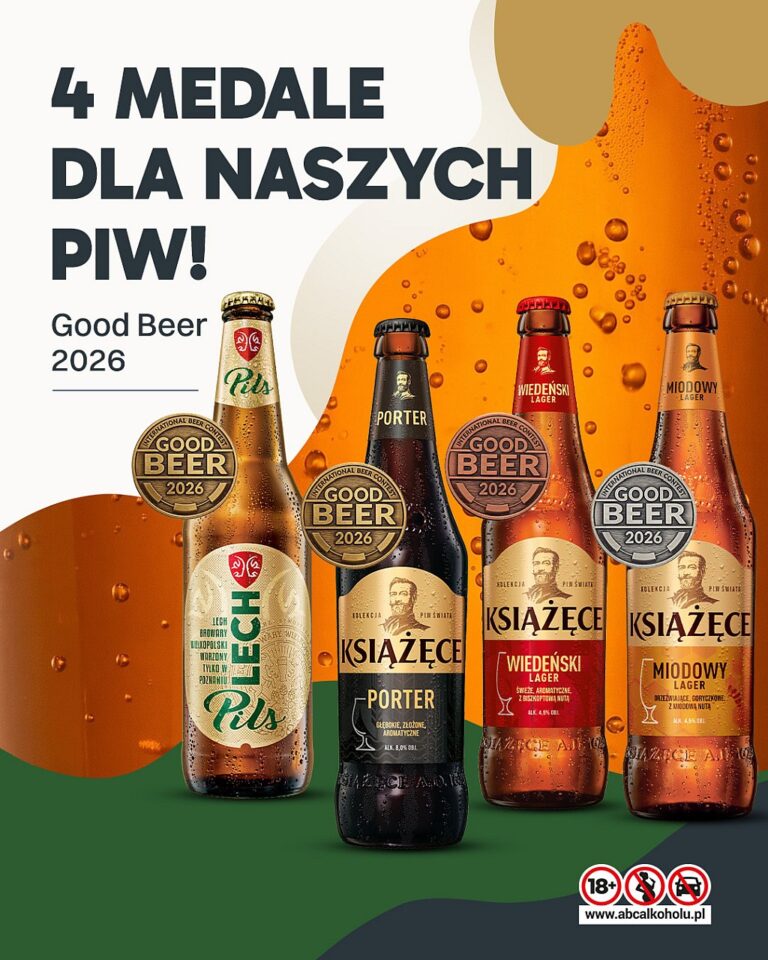
Four Good Beer medals for Kompania Piwowarska beers. Lech Pils takes gold for the second year in a row

Kompania Piwowarska invests PLN 230 million in a modern supply chain model. New automated high-bay warehouse opens at its Poznań brewery
Tyskie extends its partnership as Official Partner of the Poland National Football Team